
Introduction
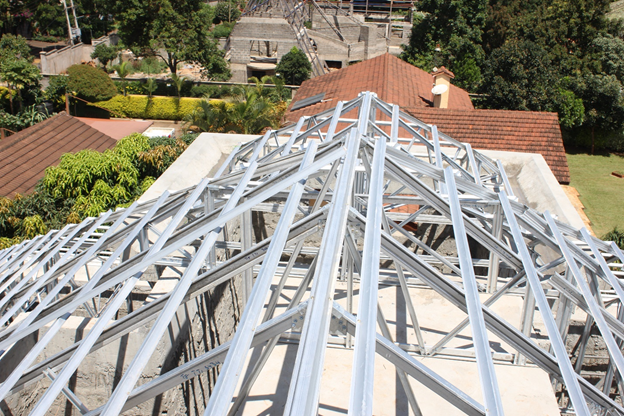
Roof Structures have evolved significantly over the years. For a long time, Timber Roof Structures have been common and popular in Kenya. However, over the last few years, many home owners, architects, engineers are changing to light gauge steel roof structures in Kenya.
Let’s understand why by looking at the advantages and disadvantages of both.
Timber Roof structure
Timber is a good a reliable structure type. It is majorly preferred because:
- Cost effective – Timber is easily available in Kenya hence affordable to many.
- Familiar to Fundis – Most Roofing Fundis in Kenya are well skilled in the installation of the structure.
- Easy to Modify – Timber trusses and battens are easily modifiable on site.
Over a long time, timber has increasingly failed to meet its purpose. This has been caused by reasons such as:
- Damage by Termites – Termites are prevalent in Kenya, and have been a major destroyer of timber roofs.
- Warping and Shrinking – Over years, wood warps and shrinks majorly due to moisture absorption and loss of inbound water from the cell walls.
- Heavy – Wood is generally heavy causing stress on walls and foundation where the structures are installed.
- Inconsistent Quality – Timber is sourced from various trees. If one is not knowledgeable on the type, he may end up sourcing poor quality which do not last.
- Additional Treatment Costs – Timber roof structure requires chemical treatment which is an additional cost to the house owner.
Light Gauge Steel roof structure (LGS)
This is the most popular roof structure in the world. It’s advantageous because:
- Durability and Strength – Steel does not retain moisture and is not affected by termites. This helps retain the shape over a long time.
- Lightweight – It’s lighter than timber reducing loads on walls and foundations.
- Fast Installation – LGS uses pre-engineered components which reduces onsite human labour costs and reduced installation time.
- Precision and Consistency – Steel roof trusses and battens are factory made, coming with exact measurements hence reducing wastage.
- Fire Resistance – Steel does not burn. In case of fire accident, the structure remains intact.
- Eco-friendly – Steel structure is recyclable and discourages disforestation.
It however has its own limitations which include:
- Higher initial costs – Requires Factory fabrication, Design Costs and Transportation Logistics.
- Skilled Installation – Not every fundi is experienced with steel, Performance can greatly be affected by Poor installation.
- Sound and Heat Conduction – Steel is a good conductor of both heat and sound, a proper insulation is required.

Why many Kenyans are preferring Light Gauge Steel to Timber roof Structure
Over the last ten years, the Kenyan market has swiftly changed from timber to steel preference. Some of the major reasons gathered include:
- Rising timber costs – Timber has significantly increased in cost here in Kenya due to shortage in supply, high demand for timber and wood and shifting government policies.
- Increased demand for low maintenance roof – Many home owners are preferring roofing systems that will not cost much over a long period of time.
- Compatibility to modern roofing solution systems – Many reliable roof covers have emerged which are best suited with steel structures.
- Increased awareness on termites and rot damages – Many Kenyans have experienced and are much aware of the damages incurred by termites, fungi and timber rotting.
- Modern architectural designs – Most modern building decisions demand precision to enhance the outcome. Steel is reliable on precision.
Conclusion
Timber has served the construction industry well for many years. However, it is time to embrace a more reliable, quality, long lasting and modern roof structures in Kenya.
Light Gauge Roof is not just an idea, it is the new future of roof structures both in Kenya and the whole world.
By Rose Wangui